They might not be planets.
At least, not the way we thought they were.
The James Webb Space Telescope has peeled back the layers on the HR 8790 system and found something messy. Huge worlds, five to ten times the mass of Jupiter, floating out there in the cold.
Classic theory said this shouldn’t happen.
The Formation Debate
How do you make a monster like Jupiter?
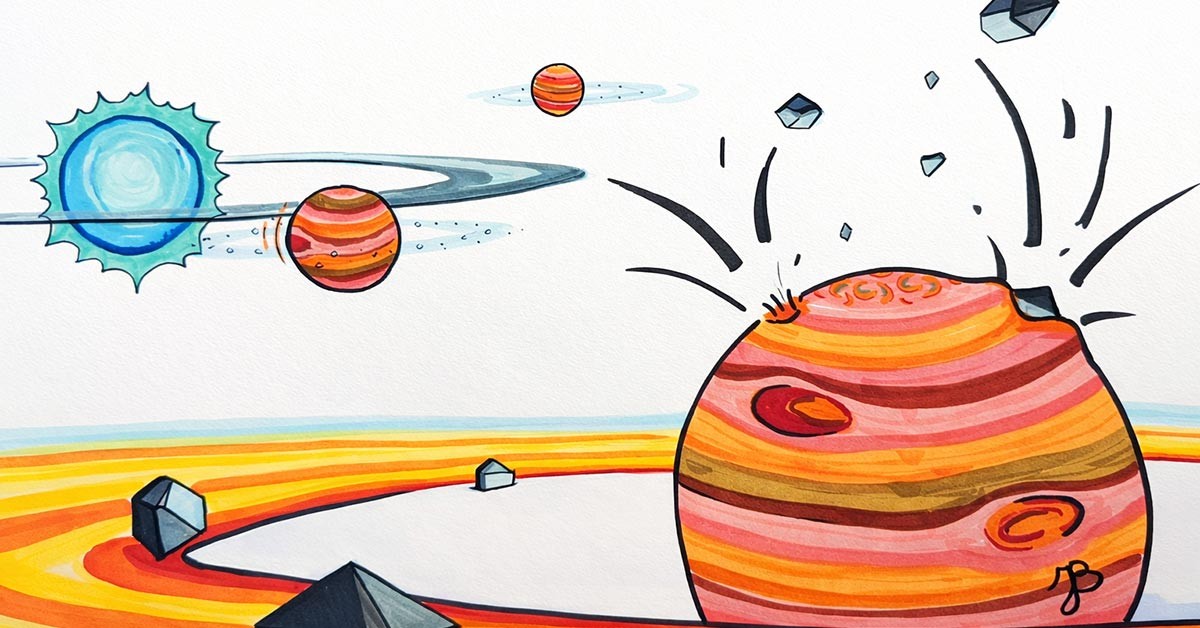
There are two camps. One side argues for core accretion: rock and ice chip away, gathering dust in a disk until the gravity is strong enough to hoover up gas. Slow. Gradual. Messy.
The other side bets on gravitational instability. A chunk of the disk collapses on itself. Fast. Chaotic. More like how stars are born than planets.
Brown dwarfs fall in the gray area between the two.
We call them “failed stars.” They are too light to ignite hydrogen fusion, but they aren’t planets either. The line has always been blurry.
It comes down to mass. Stars fuse hydrogen. Brown dwarfs fuse deuterium (just for a bit). Gas giants do nothing. They just sit there and get cold.
But where exactly do you draw the line? 13 Jupiter masses? 80?
Astronomers have argued this for decades.
The HR 8799 systems broke their models. Its four planets orbit far from their star, at 15 to 70 times the Earth-Sun distance. Core accretion theory claimed planets this far out shouldn’t form. There wasn’t enough time. The gas disk would have been swept away by the young star long before such behemoths could accrete enough mass.
Looking at the Gunk
So the UC San Diego team went looking for clues in the atmospheres.
Spectroscopy. Analyzing the light.
Before Webb, ground telescopes looked at water and carbon monoxide. Fine markers, but ambiguous origins. You can’t tell if those molecules formed with the planet or floated in from elsewhere.
The team switched targets. They looked at sulfur.
Sulfur is a refractory element. It stays solid in the hot dust of the protoplanetary disk. If a gas giant atmosphere has sulfur, that gas giant likely ate a solid core. It points squarely at core accretion.
Not gravitational collapse.
Jean-Baptiste Ruffio of UC San Diego didn’t just look; he had to invent new analysis methods. The planets were 10,000,000 dimmer than their host. The noise was deafening. He stripped it away.
What did they find?
Hydrogen sulfide.
And lots of heavy elements—carbon, oxygen, sulfur. These planets are “enriched.” They contain more metals than their parent star. Stars don’t work that way. Brown dwarfs, which form from collapsing clouds like stars, usually mirror their parent’s chemical makeup. These objects didn’t.
They built themselves.
“The HR 8799 likely formed in a similar way Jupiter did despite being five to 10 times more massive.” — Jean-Baptiste Ruffia
Shattering the Ceiling
Old textbooks are being burned.
Or at least revised heavily.
Quinn Konopacky, an astronomy professor involved in the study, put it bluntly.
The older models? Outdated.
We are looking at new frameworks where massive planets form solid cores incredibly far from their parent sun. It changes the geography of planet formation entirely.
This makes sense if you remember the HR 87 system is only 30 million years young. It is an infant compared to our 4.6 billion-year-old solar system. The heat still radiates from the formation.
But questions remain.
Because here is the uncomfortable truth.
These are massive things. The largest exoplanet candidates we have float in a weird no-man’s land.
What is a planet?
Can you be 20 Jupiters? 30?
At some point, the mass gets so high that the distinction between “planet formed by accretion” and “failed star formed by collapse” vanishes. We don’t know where that switch flips yet.
The HR 87 systems proved that giant planets can form via core accretion out in the dark suburbs.
That leaves the upper limit wide open.
We found one answer. It just raised a bigger, quieter question.