It started with a sound. Or rather, the visual equivalent of a sound: a wet, heavy thud that shattered water into mist.
In the Gulf of California, a pod of killer whales decided that a giant sunfish wasn’t just food. It was a puzzle. And the solution wasn’t to eat it whole. It was to break it.
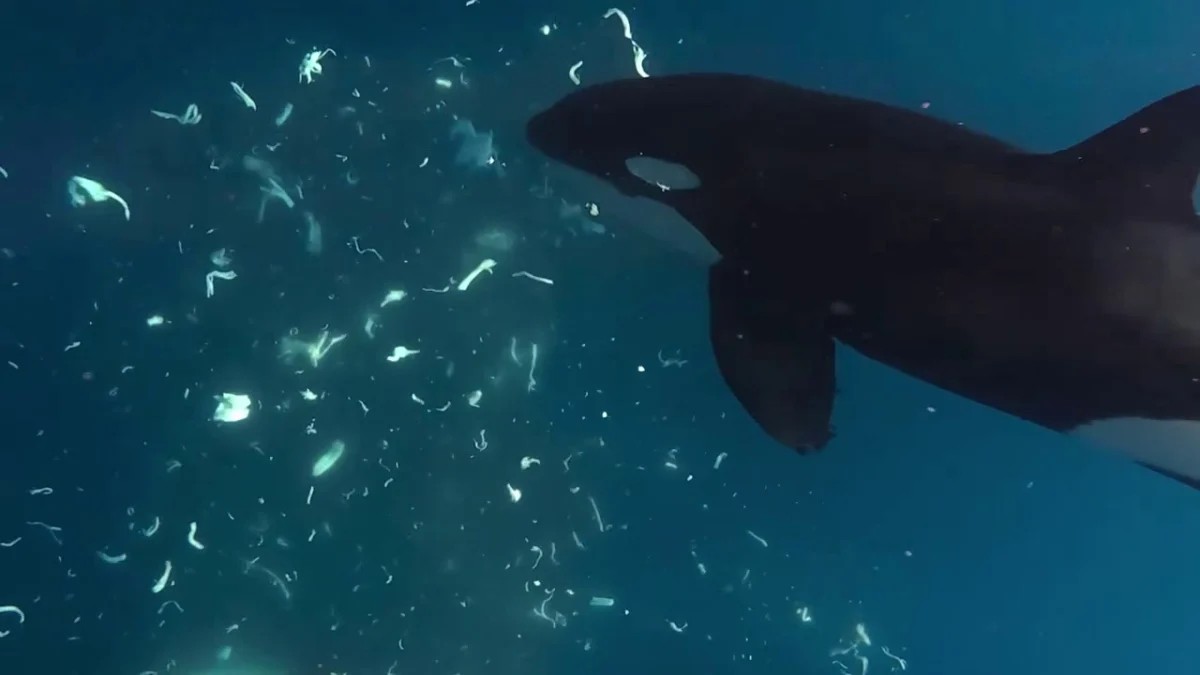
I watched footage from December 2021. An orca hits a massive Masturus lanceolatus —a sharptail sunfish—with terrifying velocity. The impact is brutal. The fish explodes. Not from inside. From outside.
ScienceAlert reported on it. Now, a new paper in Frontiers in Ethology confirms this isn’t a fluke. It’s a technique.
The “Smashing” Strategy
Let’s get one thing straight: this is not your average hunt.
Orcas are already famous for their creativity. They wave seals off ice. They flip sharks belly-up to eat their livers. They create wake waves to knock penguins off ice floes.
But hitting a sunfish until it turns to mush? That’s new.
Marine biologist Erick Higuera Rivas saw this happen in December 2021. Then again in 2024. And again in 2025.
“The first time I witnessed this behavior… the sheer energy of the impact was stunning,” Higuera told ScienceAlert. “Seeing an apex predator hit a massive fish with the sheer force was breathtaking.”
But here’s the catch.
The sunfish was likely already dead before the first orca even turned around.
Anatomy of a Smash
Why go to so much trouble to smash a fish that’s already dead?
You might assume the orcas were trying to kill it. That’s what you’d expect. You see a high-speed ram. Your instinct says: kill blow.
But the researchers dug deeper into the video frames.
They noticed something odd. The sunfish’s internal organs—the nutritious viscera—had been removed before the impact.
So what’s the point?
It’s about skin.
Sharptail mola are enormous. They are also incredibly dense. Their skin is a “waterlogged shield of collagen.”
“Sunfish skin cannot be cleanly unzipped.”
You can’t just tear it apart with teeth. It’s rubbery. Tough. Dense.
Traditional hunting relies on tearing. Tension. Shearing forces.
But collagen doesn’t care about tension. It cares about impact.
The Anvil and the Hammer
This is where it gets fascinating. It’s a coordinated team effort. Two orcas. Two roles.
One orca grabs the sunfish. It anchors itself. It becomes the anvil. It holds the prey steady against the current.
The other orca swims back. It gathers speed. It builds kinetic energy. Then, it slams into the mola.
“One acts as the anvil (the anchor) and the other as the hammer (the blast).”
The force shatters the collagen framework.
Instead of struggling to rip through dense, rubbery hide, the orcas use physics. They use massive multi-ton bodies as high-speed projectiles.
The result? The fish is reduced to manageable fragments.
Bite-sized chunks.
Easy to swallow.
Why Do It?
If the fish is dead, why waste the energy?
Two reasons.
First, convenience. The skin is too tough to tear. Breaking it is faster.
Second, learning.
Young orcas are involved.
In one 2025 sighting, a juvenile moved in to eat the pieces.
This suggests a dual purpose. Butchery for the adults. Training for the juveniles.
Orcas are playful. They manipulate objects. They use prey for practice.
Sunfish are slow. Defenseless. Low risk.
Perfect for a subadult to practice strike precision. To reinforce social bonds. To learn how to handle a uniquely difficult meal.
A New Tradition
Does every orca pod do this?
Probably not.
The researchers couldn’t identify the specific pod. But the behavior seems localized. It’s a specific strategy for a specific prey.
It joins a growing catalog of regional hunting traditions passed down through generations.
Orcas are wily. They adapt. They innovate.
We used to think we knew how they hunted.
We were wrong.
Now, we know they can smash sunfish into smithereens to make them easier to eat.
Does it mean they’re smarter than us? Maybe.
Does it mean they’re more efficient? Definitely.
Does it mean we have a lot more to learn about the oceans?
Absolutely.
The sunfish survives. Sometimes. But when the orcas decide to play, the ocean floor becomes a butcher shop. And the rules are different.