Hollywood loves a remake. Reboots are the norm there. Success? Mixed bag. Let’s not talk about Nightmare on Elm Street ever again. Painting? Not so much. People usually cringe at the thought of someone reinterpreting a classic. Unless it comes from deep space.
Then you might look twice.
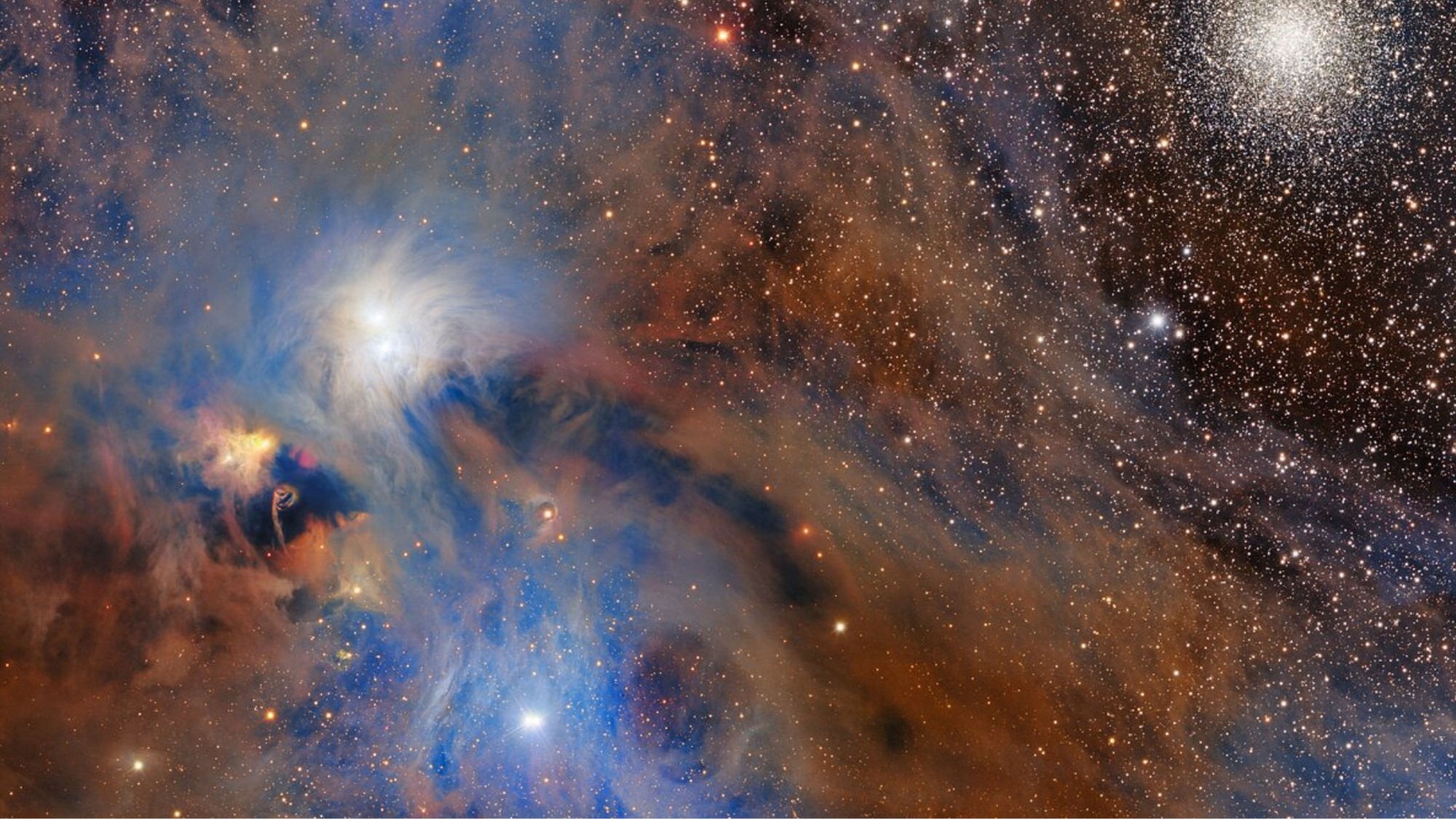
The Dark Energy Camera, or DECam, has done just that. It captured the Corona Australis molecular cloud. The result? It looks exactly like Van Gogh’s The Starry Night, just cosmic.
The resemblance isn’t a coincidence of brushstrokes, but of light.
The cloud sits about 430 light-years away. Close. Very close for space distances. It’s only 16 light-years wide, making it one of the nearest star nurseries to our solar system. Look to the left of the DECam frame. That’s where the action is. Dark lanes of gas and dust. The raw ingredients for building new stars.
There’s a bright spot on that same left side. NGC 6726, the shining nebula. It reflects light from newborn stars buried deep in the molecular cloud. Interstellar dust doesn’t create its own light here, it borrows.
Break it down. NGC 6679 has parts. On the far left, there’s an orange cloud. Actually, that’s R Coronae Australis. A binary system. Two stars orbiting each other every 45-ish years. One is pre-main-sequence, meaning it’s gathering mass, hasn’t started fusing hydrogen into helium yet. Just a hungry baby star. Its partner? A red dwarf. They are bright. Blinding, almost.
Their light hits nearby dust. Reflection nebulas light up. The radiation also ionizes the surrounding gas. Boom. Emission nebulae. Glowing reds and blues. Part of NGC 6720? Sure. It’s a mix of reflection and emission. Complicated stuff, made to look simple by a camera sensor.
Look up and right. The vibe changes completely.
Here lies NGC 6523, the Chandelier Cluster. It’s far. About 29,00 light-years out. Most of these stars are old. Really old. Some of the oldest in the Milky Way, in fact. A globular cluster holds thousands, maybe millions of them, packed in a sphere. But don’t get too nostalgic. It’s not just ancient rocks burning. There are younger stars mixed in too. A smattering. Like finding a sprout in a pile of dead leaves.
Astronomers know this sky well. Amateurs snap photos of Corona Australis. Professionals study the Chandelier Cluster for clues about our galaxy’s past. Why?
Because knowing how stars form helps us know who we are.
The camera just shows us that the old masters and the new telescopes see the same thing. Beauty. Chaos. Light spinning in the dark.
What does the rest of the sky look like? Probably boring. But that’s not why we look.