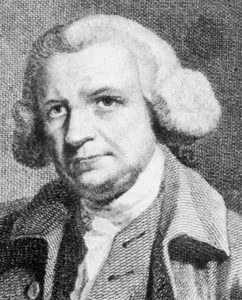
John Smeaton didn’t just build things. He defined an entire profession.
Born in Austhorpe, Yorkshire, in 1724, this English engineer died there in 1792. But his footprint is everywhere. He is the father of civil engineering in Great Britain. He also built the lighthouse on Eddystone reef off Plymouth that saved countless ships from the rocks.
Before he was an engineer, he was a craftsman. Smeaton learned to make mathematical instruments in London. It was a precise trade. He published scientific papers. The Royal Society noticed. They elected him in 1753.
Then he went to the Low Countries in 1754. He looked at their canals, harbors, and mills. It changed everything. He realized engineering wasn’t just theory. It was applied science.
The Eddystone Lighthouse and Hydraulic Lime
The Eddystone Reef was a nightmare. Two previous lighthouses had been destroyed by storms. The third one failed too. Smeaton took the job in 1756.
He needed something stronger. He used blocks of Portland stone. He dovetailed them together. This interlocking technique withstood the pounding waves. It became the standard for wave-swept structures.
But the secret was in the mortar. Smeaton tested different mixes. He found that limestone with a high clay content worked best underwater. He was the first to recognize hydraulic lime. It set hard underwater. It made the structure permanent.
“Smeaton discovered the best mortar for underwater construction to be limestone with a high proportion of clay.”
His lighthouse stood for 121 years. It was a masterpiece of stone and chemistry.
Canals, Bridges, and the Steam Revolution
Smeaton didn’t stop at the coast. He built the Forth and Clyde Canal in Scotland. It connected the Atlantic to the North Sea. He built bridges at Perth, Banff, and Coldstream. He completed the harbor at Ramsgate in Kent.
He also watched the industrial shift. He saw the transition from wind and water to steam. He improved windmills and water mills by introducing cast-iron shafts and gearing. The Royal Society gave him the Copley Medal for his work on the natural powers of water and wind in 1759.
His improvements made the Newcomen atmospheric steam engine perform at its maximum. He designed large pumping engines for collieries in Northumberland and mines in Cornwall. He even worked on docks in Kronshtadt, Russia.
Safety and Legacy
He cared about the workers. He improved the safety of the diving bell. He fitted an air pump to the bell. This kept the divers alive longer. It allowed for deeper work.
In 1771, he founded the Society of Civil Engineers. It was the first professional body of its kind. It gave engineers a voice.
He wrote Narrative of the Building… of the Eddystone Lighthouse in 1791. He documented his process. He shared his methods.
Smeaton died in 1792. The profession he founded grew. The techniques he invented are still used. The lighthouse is gone, but the